Introduction:
I stand in the bathroom, naked. I look down and see my feet, my legs, my belly, my breasts. I look in the mirror and I see my face. I hold my hand up to my face and run my fingers over my bones, my eye sockets, my cheeks, my jaw. I hold my hand out in front of my face for examination. I see my palm directly in front of me and the back of my hand in the mirror. I again hold my hand to my face. I look at my eyes and lips, my nose. I realize I will never gaze directly upon my face. I will only know it through reflection. I will live my entire life without the ability to actually see my own face.
I look out and see the world. I see the faces of others. I gaze upon the face of my beloved and my beloved gazes upon my face. I am known by my face. In so many ways I am my face. Yet, I will never truly see my face. This inability—this lack—is disturbing. It is an irresolvable unknowing akin only to the perpetual unknowing I feel in relation to God. I am not like Hagar who asked, “Have I really seen God and remained alive?” (Gen 16:13) or Jacob who said, “For I have seen God face to face, and yet my life is preserved.” (Gen 32:30) or Moses who’s face used to shine after speaking face to face with God (Ex 33 and Ex 34). Unlike these three, I have not seen God. I feel more truth in the contradictory verse, “you cannot see my face; for no one shall see me and live” (Ex 33:20). I cannot see God’s face or I will die. I cannot see my face because it’s a physical impossibility. My lack is amplified. I am unable to fully know myself. I am unable to fully know God.
In order to experience the reality of my existence, however, I must respond in some way to this unknowing. If I don’t respond, I run the risk of disappearing—of losing myself. So I hold dearly to the fact that there is something I know. I know I am an embodied human being. In the first few passages of Genesis there is a discussion regarding the creation of human beings: “Then God said, ‘Let us make humankind in our image, according to our likeness’…So God created humankind in God’s image, in the image of God, God created them; male and female God created them” (Gen 1:26-27). There are also specific details in the story about how human bodies were created: “Then the Lord God formed man from the dust of the ground, and breathed into his nostrils the breath of life; and the man became a living being” (Gen 2:7). God caused a deep sleep to come over this living being and removed a rib from the sleeping flesh. “And the rib that the Lord God had taken from the man he made into a woman” (Gen 2:22a). This story is the work of someone from thousands of years ago. Someone who wrestled with the same questions I’m wrestling with today. The conclusion this person came to—that of a God breathing into the dust and raising up a being in the likeness of God—is overwhelmingly beautiful. I am happy to imagine myself as a combination of dust and bone and holy breath. I also appreciate the possibility that through the exploration of my image, I might come closer to an understanding of God’s image. Through the exploration of myself, I might meet God.
So where do I look? How do I begin my exploration? Certainly every time I make statements such as “I am a woman / I am married / I am an artist / I am religious” I am striving for self-knowing, for self-identification. But can any of these statements or even a combination of them explain who I truly am? How do I go deeper, beyond superfluous descriptions? How do I reach my internal self? I’m not sure I can, but I know how to try. Just like the writer of Genesis, I have to think about creation and I have to be creative. Throughout the span of human existence, human beings have worked to understand the mystery of being through acts of creation. Human beings write autobiographies, draw, paint, sculpt and photograph themselves. We record images of our bodies moving and the sound of our voices speaking. We take pencils in our hands and make marks on pieces of paper in an attempt to make our inner thoughts become external visual reality. We stare at the reflection of parts of our bodies in the mirror; we can never see ourselves in entirety. We touch our skin and watch our muscles move. We try to figure out who we are. We strive to unite our internal and external selves—our fragmented self.
Through the creation of self-portraits, humans are given an opportunity to ask questions of themselves and then to work at expressing something of what they learn internally to the external world. Self portraiture is a form of communication. We communicate with ourselves throughout the act of creating and we communicate with others as they view our creation. We work at achieving the impossible—the unification of our internal and external selves. We look at our finished product, whether written or painted or something else, and know that we have failed. But hopefully we feel closer. Hopefully we can recognize that we have gained something from the search, that we have built a wobbly, distorted bridge between inside and out. Then we decide how to react to our creation—our bridge to better self knowledge. Are we like God in the book of Genesis who over and over again paused to notice goodness? God called the creation good. This recognition indicates the possibility that it could have been otherwise. After the creation of humanity, “God saw everything that God had made, and indeed, it was very good” (Gen 2:31a).
Six Self-Portraits Examined:
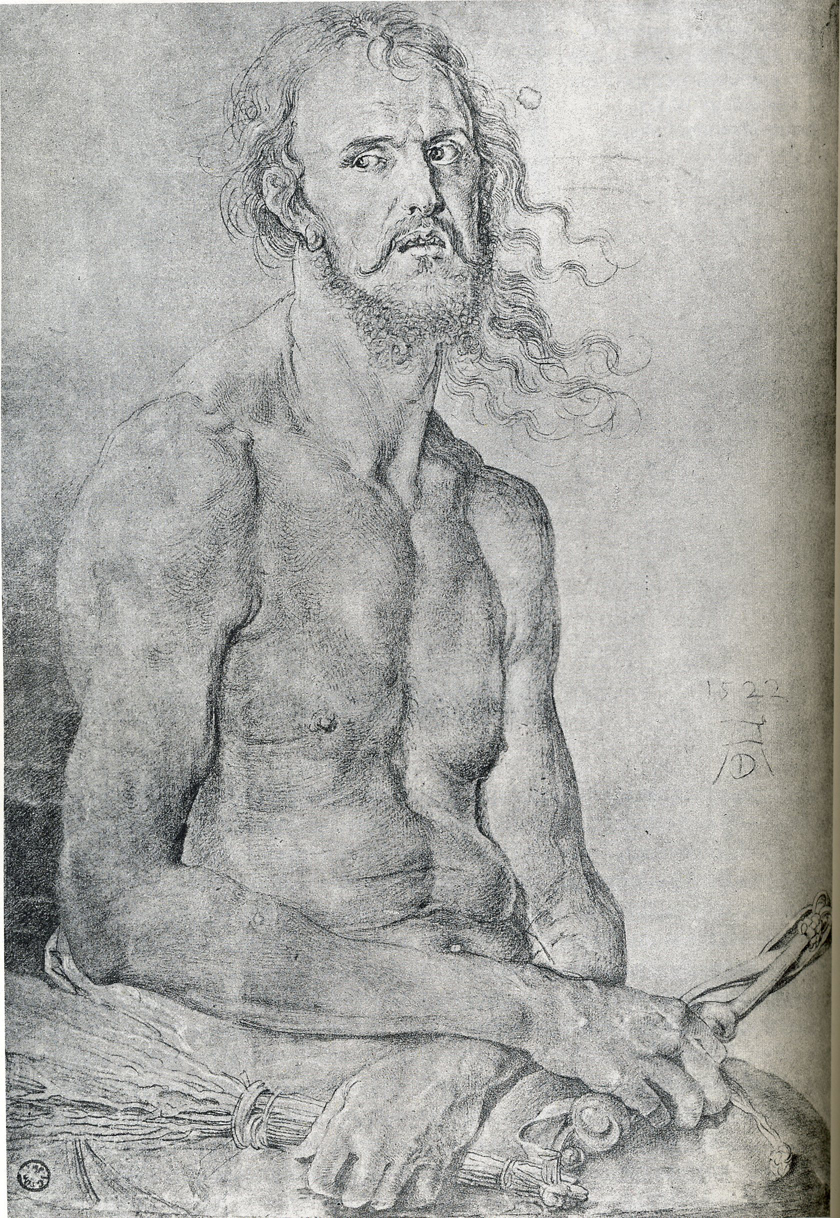
Albrecht Durer (1471-1528) The Man of Sorrows, 1522
In this portrait Durer shows a vulnerability usually absent in his self-
portraits. I am more familiar with the forward facing, beautifully draped
body with focused eyes that he painted in 1500. In this metal point
drawing, I am able to see thinning hair, slouching shoulders, downcast
eyes and bare skin. I see something of the way Durer understood
himself at the age of 51, five year before he died. His mouth is slightly
ajar; his belly is relaxed. His eyes don’t attempt contact with the viewer
but they are clearly focused. His brows furrow in a way that
communicate deep concentration. But what is he thinking? This is
where the bridge that he built for himself through the creation of this
work falls apart for me. I cannot cross it. The drawing is for him. I am
left on the outside, unable to understand anything more than glimpses of
the internal world of Durer. I wonder what he learned through the
making of it? Did the dreams of the man from 1500 come true for the
man in 1522?
Rembrandt van Rijn (1606-1669) Self Portrait, 1652
Rembrandt created over 70 self portraits. He drew them, he etched
them, he painted them. They span decades of his life. What was he
searching for as he repeatedly studied his own face? After taking a 7-
year hiatus from self portraits, Rembrandt painted this one in 1652. His
face glows out from the picture plane and his eyes look directly at the
viewer. His hands are on his hips and he is dressed casually; one would
guess he’s wearing his everyday working clothes. I get the sense that I’ve
just interrupted him and that he is waiting somewhat impatiently for an
explanation regarding my intrusion. He seems to be daring me to speak.
But maybe he’s not looking at the viewer at all. Maybe he’s staring down
his own reflection and calling himself back into the internal conversation
he’d been ignoring for seven years. He looks confident and inquisitive,
but worn down. What prompted him to return to himself as subject?
What is he asking himself through his searching, tired eyes?
Egon Schiele (1890-1918) Self Portrait With Arm Twisted Above Head, 1910
Following the call of Emily Dickenson, I believe that Egon Schiele tells
the truth, but tells it slant. Here he presents his body distorted, with
bones larger than life. The combination of his massive back and
protruding lower ribs suggest that his entire torso is rocking. His face
and elbow, portrayed here as roughly the same size, line up on either
side of his lengthened, straight arm. His fingers are stretched; his body
is elongated. He was 20-years old when he painted this image of himself.
Who did he imagine himself to be? His eyes look straight out, but at
what the viewer has no way of knowing. He looks angry, but also slightly
in pain. He is somehow simultaneously emaciated and exaggerated. Did
he feel both confidence and insecurity? This self portrait offers clues
about Schiele’s self perception. But on a much deeper level, it helps me
to understand my own self perception. Don’t I also have confidence and
insecurity? Don’t I also feel both emaciation and exaggeration in my life?
Through his self exploration, Schiele prompts me towards my own.
Kathe Kollwitz (1867-1945) Self Portrait, 1938
Kathe Kollwitz is someone who spent years documenting human
suffering in a way that showed how keen her attention was. Kollwitz
truly saw the suffering. This self portrait, painted seven years before her
death, emphasizes the weight of this knowledge within her body. She is
standing, looking at the world in front of her, a world that is not
available to the viewer. Her hands are clasped behind her back and it
seems as though she has just exhaled. Her posture is casual; she looks
content in the moment. Yet the entire image exudes heaviness. Her face
is shaded, the light source is at her back. Her body melts into itself,
there are only a few shadows that separate her arm from her torso.
Everything about her form is soft, her belly and neck, even her eyebrow.
This portrait seems to accomplish the impossible—to expose the internal
externally. Sitting with this image of Kollwitz, I begin to breath more
slowly and to feel heavier. I am saddened, but not made anxious. Her
image communicates knowing and acceptance. She has seen what she
has seen and offered what she could. For this self portrait she turned
her awareness inward and stands before the viewer completely exposed.
Frida Kahlo (1907-1959) Self-Portrait with Loose Hair, 1947
Frida Kahlo painted several self portraits. She spent her lifetime
wrestling with questions of identity. In this painting she combines the
visual image with the written word. It seems she didn’t want to leave any
unanswered questions. She tells us that she used a mirror to get her
likeness, her age, the date and her location. She elaborates on where
she is, explaining that this is the city of her birth. Kahlo is clearly trying
to communicate something specific with this work. Yet her eyes are
oddly detached. She seems sucked inward, unaware of anything going
on around her. It’s as if she needs the lettered sign in order to
communicate with a passerby, as if she fears she wouldn’t notice them.
The painting is a contradiction. On one hand she says here I am, plain
as day. But as the viewer tries to look, tries to see, they realize she’s
gone. All she actually offers is a dazed stare. The exploration and
communication is happening internally. The external world is only
given a few distractions, a few obvious descriptions.
Kiki Smith (b. 1954) Free Fall, 1994
This print invites the viewer to participate. In fact, we have no choice.
By opening the book and unfolding the print, the viewer “drops” the
artist. We participate in her fall. Her eyes are closed; she doesn’t seem
fearful. But what should our reaction be? Can we catch her, keep her in
perpetual free fall or should we fold her back up and not worry about
her any longer? Kiki Smith refuses to allow the viewer a simple window
into herself. She’s making a bargain with her audience. She’s willing to
expose herself, to explore creation through her body. But the audience
is not allowed to simply become voyeurs on her journey. We are forced
to react and respond. Will we keep the book closed?
My self-portrait:
Myself in Pieces, 2009 (abbreviated)


Conclusion:
Here I stand on the other side of looking; on the other side of a wobbly, distorted bridge between inside and out. I know that I am fragmented. I cannot look completely upon my own body, yet I cannot escape my body. I’ve learned that my inner and outer lives are more connected than I am always able to feel. But I also know that I can separate myself into parts. Here are my toes; here is my stomach. Here is my joy and pain. Here is what you see. But here is what you don’t see. My guts hold more knowledge than I have ever given them credit for. I tend to give my mind all the credit. Science has taught me that the brain controls most (or is it all?) of my functioning and so I ignore the other pieces of myself. If I think I am my brain, shouldn’t I also think that I am my knee? But I could survive without a knee, couldn’t I? But would I be the same? The mystery of my being grows larger. I am learning that I will understand far less of myself than I will ever know. But—and here’s the rub—mystery would mean nothing if it didn’t contain at least something that can be grabbed. The more I look at and try to understand the reality of existence, the more I realize the importance of these little moments of knowing, these handles. Every time I find a handle—the feeling of truth in my guts—I have the urge to follow the instructions given to Moses in the book of Exodus: “Remove the sandals from your feet, for the place on which you are standing is holy ground (Ex 3:5). Of course, I have to remember that before Moses was told to take off his shoes, he was told “Come no closer!” (Ex 3:5). In other words, I may find handles, but I won’t find definitive answers. So I take fragments of knowledge when they come and I bless them. According to the imagination of an ancient writer I am dust and bones and holy breath. I am made in the image of a God who said, “I Am Who I Am” (Ex 3:14). I know myself to be an embodied being fully alive and capable of contemplating mystery. In the image of the God of Exodus, I too can say, I am who I am.


 Posts
Posts